

In today’s business landscape, decision-makers have more marketing data available to them than ever before. Whether it’s:
- Google Analytics
- Google Search Console
- Social Media Platforms
- PPC Dashboards
- CRM Systems
or
- SEO Tools
Businesses can monitor nearly every digital interaction. But the biggest problem is not getting the data. It’s defining what really works in digital marketing for businesses.
There are many companies that celebrate the growth of their website traffic, followers, impressions, clicks and keyword rankings. Numbers such as these can reflect visibility but don’t necessarily translate to higher-quality leads, sales, or revenue.
Businesses should do fewer numbers and more metrics that will provide insights into the quality of visitors, conversion rates, cost of customers and marketing ROI.
It’s not necessarily the highest number you see on the dashboard. It’s the one which facilitates businesses in making better choices.
What Are Vanity Metrics in Digital Marketing?
Vanity metrics are numbers that could be juicy to look at but fail to reveal whether marketing is actually driving business results.

This can be any kind of traffic on your website, social media followers, impressions, clicks, etc. While these metrics can be useful indicators, they can also be misleading if businesses rely solely on them as a yardstick for success.
It is a common difference.
Activity metrics indicate what’s going on. The reasons behind the importance are demonstrated in outcome measures.
There are three levels of a good marketing measurement framework:
Attention Metrics
- Impressions: The number of times your content, ad or webpage is seen by a user, whether or not they interact with it.
- Reach: The size of your audience exposure – the number of distinct users who have viewed your content.
- Traffic: The quantity of visitors that visit your website, landing page, or digital channels from various sources.
Action Metrics
- Clicks: Initial user interest or intention, as measured by the number of clicks on ads, links or content.
- Engagement: Measures user interactions such as likes, comments, shares, saves, time spent, or other activities with your content.
- Leads: The number of people who provide their information and/or express interest in your product or service.
- Conversions: The proportion of users who reached a desired goal, such as a purchase, sign-up or service request.
Business Outcome Metrics
- Revenue: All the revenue generated from marketing activities, sales or customer transactions.
- Customer acquisition cost: The total cost of acquiring a new customer through a marketing/sales campaign.
- Profitability: How much money your business makes once all your marketing, operating and other costs have been taken out.
- Customer lifetime value: An estimate of the total amount of money a customer will spend on your brand over their lifetime.
Data isn’t the end goal of modern marketing analytics. It’s about comprehending the numbers that link marketing and business expansion.
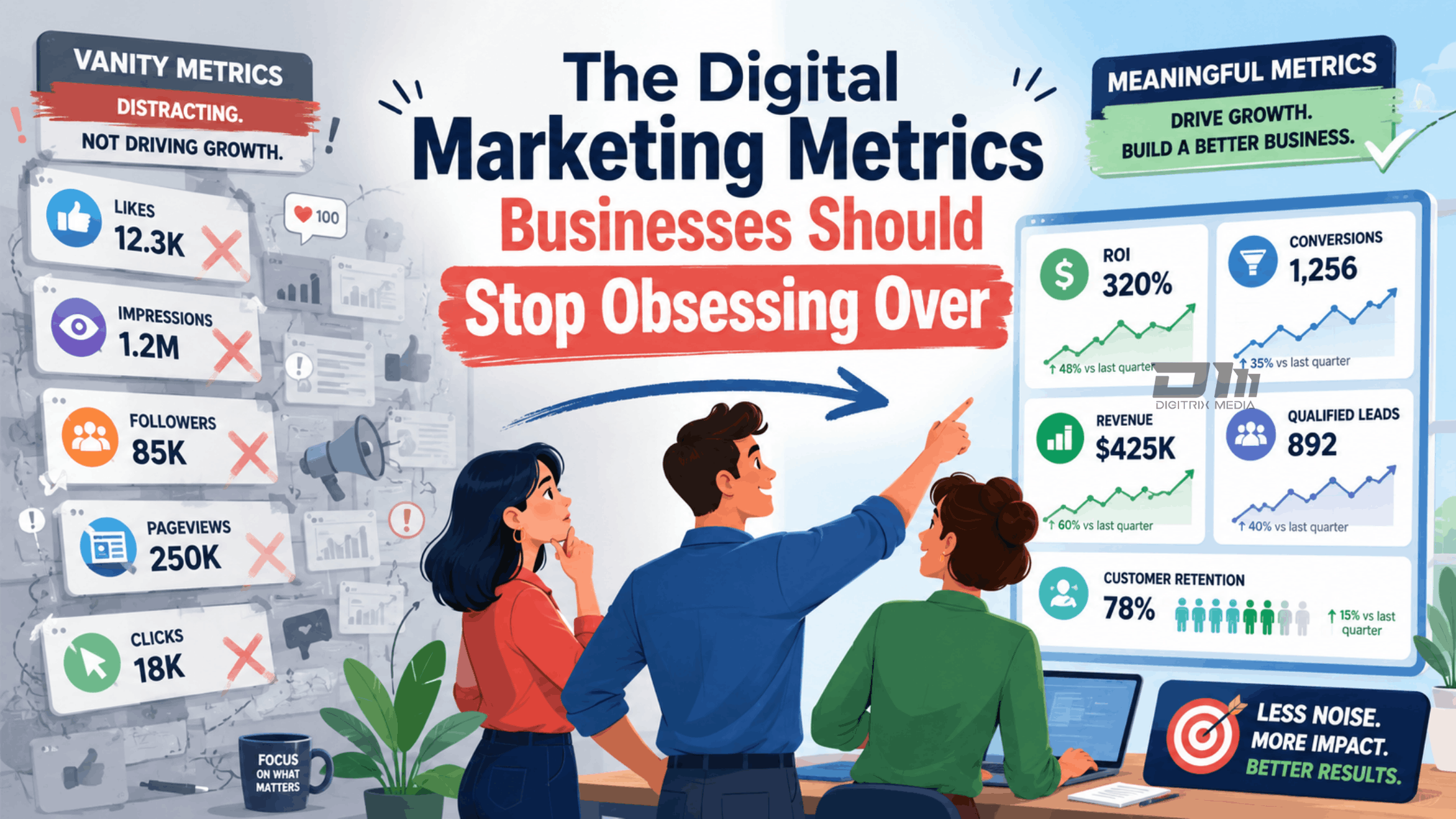
6 Digital Marketing Metrics Businesses Should Stop Obsessing Over
1. Total Website Traffic
One of the first stats that businesses review is website traffic. An improvement in the number of visitors tends to indicate a more effective SEO strategy, content marketing or advertising efforts.
But overall traffic volume is just part of the picture. It doesn’t tell you whether your visitors are relevant, whether your visitors are in your target audience, whether your visitors stay on your site or whether they are likely to convert.
A high-visitor website with a lot of visitors who are not targeted can perform much worse than a lower-visitor website that has a lot of visitors who are targeted and purchase more often.
Businesses should look at the qualified traffic, conversion rates, leads generated, revenue per visitor and source-to-conversion engagement metrics, rather than just traffic.
Traffic is not a full-fledged indicator of marketing success.
2. Social Media Follower Count
People can be impressed with the number of followers and think that that gives them authority. But follower numbers tell little about business performance.
Platform algorithms change, meaning that many followers won’t see your posts. Some may not be in your target market, care less about your products and services or never interact with your content.
The number of leads that can be generated from a highly engaged audience of 5,000 viewers is much greater than the number of leads that can be generated from an inactive audience of 100,000 viewers.
Instead of just focusing on follower numbers, businesses should look at shares, meaningful comments, profile visits, website traffic from social media and conversions.
A smaller, but more relevant, audience is typically of greater value than a larger audience that is unlikely to be engaged.
3. Impressions and Reach
Impressions and reach are great metrics to gauge brand awareness but do not mean business success.

An impression is when material is displayed on a screen. It does not prove the user has seen the message, read it and remembered the brand.
Similarly, reach can be a good indicator of how many people may have seen your content, but not how many interacted with it.
These metrics are applicable for awareness campaigns. But companies need to also consider video completion rates, engagement, branded searches, actions on their sites, and assisted conversions to determine if awareness is converting to actual customer action.
Increased visibility is not enough to grow business.
4. Click-Through Rate (CTR)
One of the most common metrics for PPC, email marketing, and search ads is click-through rate, which indicates the number of times users click on a message.
A high CTR can, however, not always translate to good marketing performance.
Clicks can be from:
- Curiosity
- Poor targeting
- Misleading messaging
- Low-intent audiences
The fewer clicks, the better the results, if the clicks are from customers with more buying intent.
Businesses should track:
- Conversion rate
- Cost per qualified lead
- Lead quality
- Customer acquisition cost
- Revenue generated
Clicks lead to opportunity; conversions lead to business value.
5. Keyword Rankings in Isolation
In the past, keyword rankings were the primary indicator of SEO success since entrepreneurs need to understand the position of their website in search results.
But rankings do not indicate the impact of SEO on business.
A webpage can be very highly ranked and yet not produce:
- Qualified visitors
- Leads
- Sales
- Revenue
The way people search is evolving as well, thanks to AI overviews, chat searches, and zero-click results.
Businesses should measure the following:
- Qualified organic traffic
- Organic conversions
- Revenue from search
- Non-branded visibility
- AI search visibility
- Brand mentions
It is not simply about ranking higher anymore to be a successful SEO. It’s all about building a trusted source on search journeys.
6. Cost Per Click as a Standalone PPC Metric
The CPC is a popular metric in PPC, as it presents the amount of money businesses spend to get visitors to their website via ads.
While a lower CPC might be appealing, a lower cost doesn’t necessarily mean a better performance.
- Low-cost clicks can lead to:
- Unqualified visitors
- Poor leads
- Low conversion rates
- Lower customer value
Businesses need to track metrics that have a direct link to real
performance:
- Cost per qualified lead
- Conversion rate
- Customer acquisition cost
- Return on ad spend
- Customer lifetime value
Not all the time the cheapest click is the most profitable click.
Also Read: Why Are My Google Ads So Expensive? (5 Hidden Budget Leaks and How to Fix Them)
What Should Businesses Measure Instead?
Marketing needs to be evaluated throughout the entire customer lifecycle.
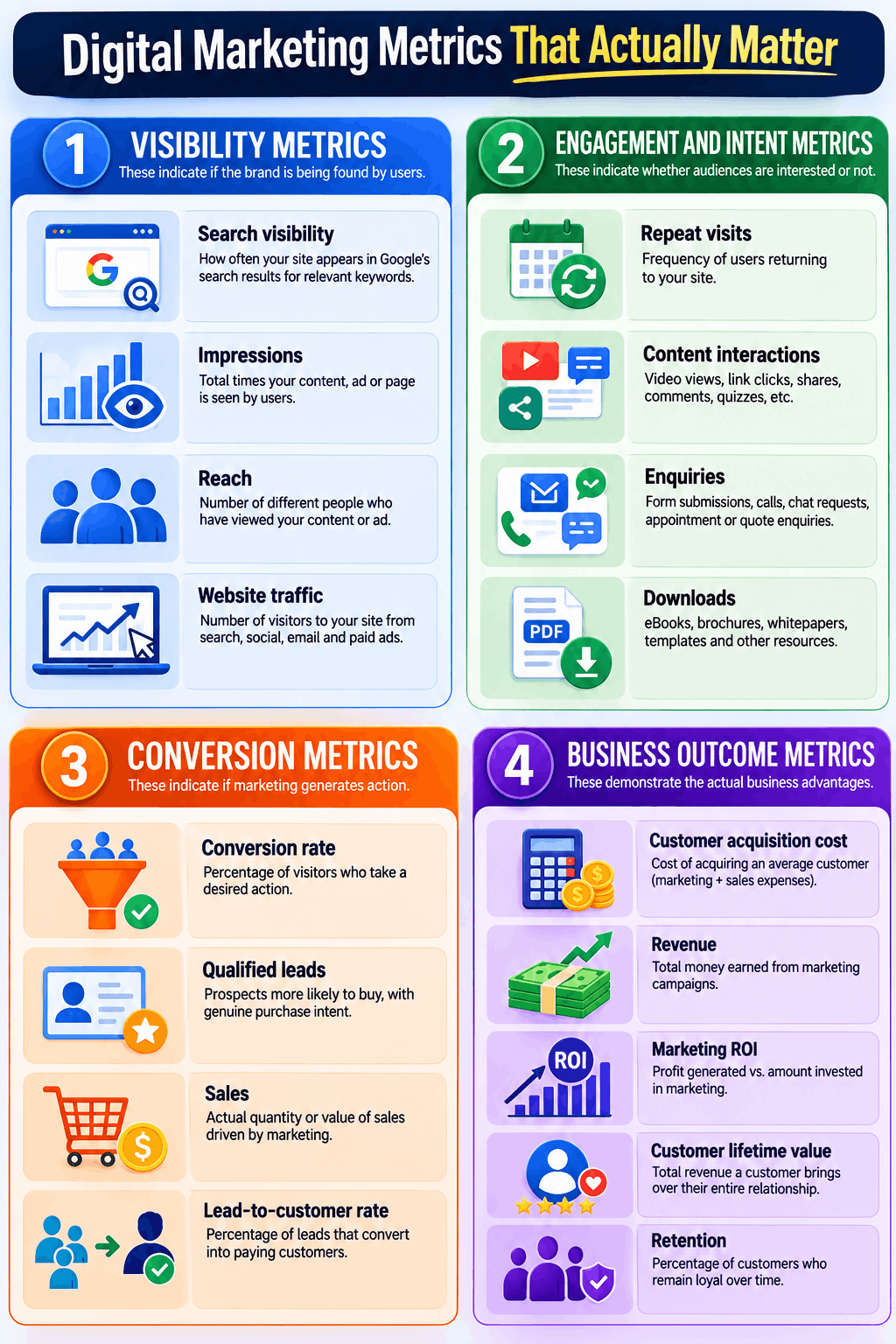
The Right Marketing KPI Depends on the Business Goal
No single digital marketing metric is for all businesses. The appropriate KPI will be determined by the goal.
When it comes to building brand awareness, look at reach, impressions, video completion rates and branded search growth.
Focus on qualified leads, cost per qualified lead, conversion rate and lead-to-customer rate in the context of lead generation.
Track conversion rate, average order value, customer acquisition cost, customer lifetime value and repeat purchases for e-commerce.
If you are looking at SEO, success should be measured by qualified organic traffic, organic conversions, revenue, search visibility and AI search visibility, not rankings.
The ideal KPI is always the one that helps to make better business decisions.
How Businesses Can Build a Better Marketing Measurement Strategy
A better measurement is based on business goals.
- Set a goal – more leads, more sales, more awareness.
- What their action is (e.g., buying a product, enquiring about something, or booking a service).
- Take measurements of the marketing efforts that impact that behaviour.
- Distinguish between leading and lagging metrics, such as traffic and engagement vs revenue and retention.
Consider reviewing metrics as a group, rather than relying on a single metric. None of the metrics can be used without context, which is why professional oversight ensures your data tells the complete story of your business growth.
Conclusion
Numbers such as traffic, followers, impressions, clicks, or rankings aren’t something that businesses should overlook. These figures will still give a good indication of visibility and audience reaction. The error is to see them as a measure of success without making them part of the business results.
Marketing measurement should take the path:
Visibility → Engagement → Intent → Conversion → Revenue
It’s not just a matter of collecting more and more data; it’s about the future of digital marketing analytics. It’s all about knowing what information is responsible for growth. Companies that concentrate on actually delivering value and not a big number will create more successful and more lucrative marketing strategies.
Frequently Asked Questions
Which are the key digital marketing metrics?
Some of the most common metrics are qualified leads, conversion rate, customer acquisition cost, revenue, marketing ROI, and customer lifetime value.
Do website visitors and followers really matter?
Not always. The success of the website can be indicated by traffic and followers. They’re vanity metrics when companies just track them without digging into conversion rates, engagement, quality of customers or revenue impact.
Why is it that keyword rankings are not a good metric for measuring SEO success?
Keyword rankings indicate the visibility of a site in search engines; that is, they do not necessarily mean that a business is doing well. Organic conversions, qualified traffic, revenue, AI search visibility, and brand mentions are also important metrics to monitor.
So what are the metrics to replace impressions?
Businesses should track the results of their campaigns according to their marketing goals, the engagement quality, website actions, leads, conversions, brand growth, and revenue contribution.
What is a company to do to calculate digital marketing ROI?
Marketing ROI can be calculated by dividing the value created by the marketing efforts by the marketing investment. This should include customer acquisition cost, customer lifetime value, profit margins and revenue.